Pablo Neruda Poems
Pablo Neruda Biography
 His birth name was Ricardo Eliecer Neftali Reyes Basoalto, but most people know him as Pablo Neruda. He was a Chilean poet, born in 1904, who also had a penchant for politics. In fact, in 1923, Neruda sold all of his personal belongings in order to pay for the publication of his very first collection, Crepusculario (which means Twilight). This volume was published under the pen name of Pablo Neruda which was an attempt at avoiding a conflict with members of his family. Apparently, they disapproved of his being a poet. The next year, he acquired a publisher for his next work, Twenty Love Poems and a Song of Despair. This second work place Neruda into the category of celebrity. It’s interesting to note that he gave up his formal studies when he was just twenty years of age in order to pursue a fulltime career in poetry.
Viejo Ciego, Llorabas (from Crepusculario)
by Pablo Neruda

A few years later, Neruda embarked on a new aspect of life, that as being a diplomat. This followed a long standing tradition of honoring poets by asking them to fill certain diplomatic assignments. He served in Burma for a few years as the honorary consul there, and was then later assigned to the conulate in Buenos Aires. During his tenure there, he became friends with Federico Garcia Lorca, who was a Spanish poet visiting Argentina. Neruda later transferred to the consulate in Madrid, where he meet up with Manuel Altolaguirre, the well known Spanish writer. The two men collaborated and formed a literary review publication; however, with the start of the Spanish Civil War a few years later, his political and poetic activities were brought to an unexpected halt. During that upheaval, Neruda wrote extensively about the war in Spain, including the execution of Garcia Lopez. He was recalled by his home country due to his apparent sympathy for the loyalists during the war.
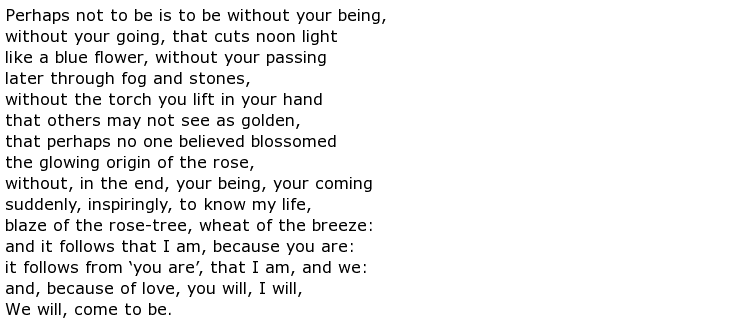
Perhaps not to be is to be without your being
by Pablo Neruda
His political endeavors continued upon his return to Chile. Likewise, his writing also increased dramatically during this time. He served for four years at the consulate in Mexico, and earned a seat in the Senate. He also placed his membership with the Communist party at the time. This ultimately caused Nerudo to go into hiding after the Chilean Government denounced communism. It was during that time period that he penned Canto general in 1950.
A couple of years later, the Chilean Governement suspended the arrest order on communist writers and politicians, which allowed Neruda to return to Chile. He continued writing and was ultimately awarded the International Peace Price, the Stalin Peace Prize, and the Lenin Peace Prize, followed by the awarding in 1971 of the Nobel Prize in Literature.
A Dog Has Died
by Pablo Neruda

Neruda was diagnosed with cancer during the time that he was ambassador to the French Government. He resigned shortly thereafter and returned to Chile where he died a year later.