Charles Bukowski Poems
- 16-bit Intel 8088 chip
- 40,000
- 8 Count
- A Challenge To The Dark
- A Following
- A Man
- A Radio With Guts
- a smile to remember
- Alone With Everybody
- An Almost Made Up Poem
- And The Moon And The Stars And The World
- Another Day
- Are You Drinking?
- As The Poems Go
- As The Sparrow
- back to the machine gun
- Be Kind
- Big Night On The Town
- Bluebird
- Carson McCullers
- Cause And Effect
- close to greatness
- Confession
- Consummation Of Grief
- Cows In Art Class
- Curtain
- Cut While Shaving
- Death Wants More Death
- Decline
- Eat Your Heart Out
- Eulogy To A Hell Of A Dame
- Finish
- finished?
- Flophouse
- For Jane
- For Jane: With All the Love I Had, Which Was Not Enough:
- Freedom
- Friends Within The Darkness
- gamblers all
- Girl In A Miniskirt Reading The Bible Outside My Window
- having the flu and with nothing else to do
- hello, how are you?
- Here I Am …
- His Wife, The Painter
- Hooray Say The Roses
- Hot
- How Is Your Heart?
- I like your books
- I Made A Mistake
- I Met A Genius
- I’m In Love
- it was just a little while ago
- It’s Ours
- Jane Icin (For Jane – In Turkish)
- Layover
- Let It Enfold You
- Like A Flower In The Rain
- Love & Fame & Death
- Luck
- magical mystery tour
- Mama
- Marina
- Melancholia
- Metamorphosis
- my computer
- my father
- My First Affair With That Older Woman
- my friend, the parking lot attendant
- My Groupie
- New Mexico
- Nirvana
- No. 6
- Now
- O, We Are The Outcasts
- Oh Yes
- On Going Back To The Street After Viewing An Art Show
- one thirty-six a.m.
- Out Of The Arm Of One Love…
- Paris
- Poem For My 43rd Birthday
- Poetry
- Prayer In Bad Weather
- Pull A String, A Puppet Moves
- Question And Answer
- Rain
- Rain Or Shine
- Raw With Love
- Revolt In The Ranks
- Rhyming Poem
- Shoes
- Short Order
- Show Biz
- Sleep
- small conversation in the afternoon with John Fante
- So Now?
- Some People
- Somebody
- Something For The Touts, The Nuns, The Grocery Clerks, And You . . .
- splash
- Sway With Me
- The Aliens
- The Blackbirds Are Rough Today
- the crunch
- The Genius Of The Crowd
- the German hotel
- the great slob
- The History Of One Tough Motherfucker
- The House
- The Icecream People
- the lucky ones
- The Meek Shall Inherit The Earth
- The Most
- The Most Beautiful Woman In Town
- The Night I Was Going To Die
- The Poetry Reading
- The Retreat
- The Shower
- The Sun Wields Mercy
- The Worst And The Best
- These Things
- This
- Three Oranges
- To The Whore Who Took My Poems
- Trapped
- Trashcan Lives
- True
- True Story
- We Ain’t Got No Money, Honey, But We Got Rain
- What A Writer
- What Can We Do?
- Whats The Use Of A Title?
- Who In The Hell Is Tom Jones?
- Working Out
- Writing
- Yes Yes
- Young In New Orleans
Charles Bukowski Biography
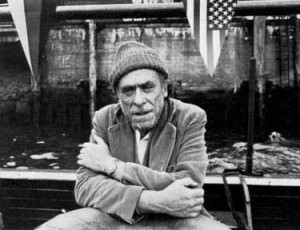
Charles Bukowski (1921-1994) is a poet of bluntness. With over 120 poems, most of these are easily associated with because of the manner in which each of these poems comes forth. Where poets of the older eras typically kept with a rhyme scheme or in some instances deliberately tried to make their works metaphorical and mystical, Charles Bukowski’s works tend to lean more to a conversational tone.
Life in all its dirtiness
Though many would argue that Charles Bukowski’s poems are more rants than poetic, there are others which would point to the emotions which are captured within the poems. One needs to keep in mind that it is not their personal convictions which make a poet. In doing so one can look beyond the word usage and those words which we commonly refer to as “curses” or “blasphemous” and look at the overall message which is trying to be conveyed.
Perhaps it was the era in which Charles Bukowski lived which weighed the most upon his subject matter. The poet lived through both world wars as well as the Vietnam War. It is clear to see from his works that there is a skepticism and bitterness that can only be attributed to seeing such times. Yet, the wars of this world were only a part of the influence in which Charles Bukowski life played upon his works. From his works, one can see that there is a love or lovers theme that carries throughout. This is not at all to state that these are love poems. On the contrary, most of these poems show a desire to have an actual relationship but the lack to actually obtain such. In the poem “I made a mistake” we can see this clearly.
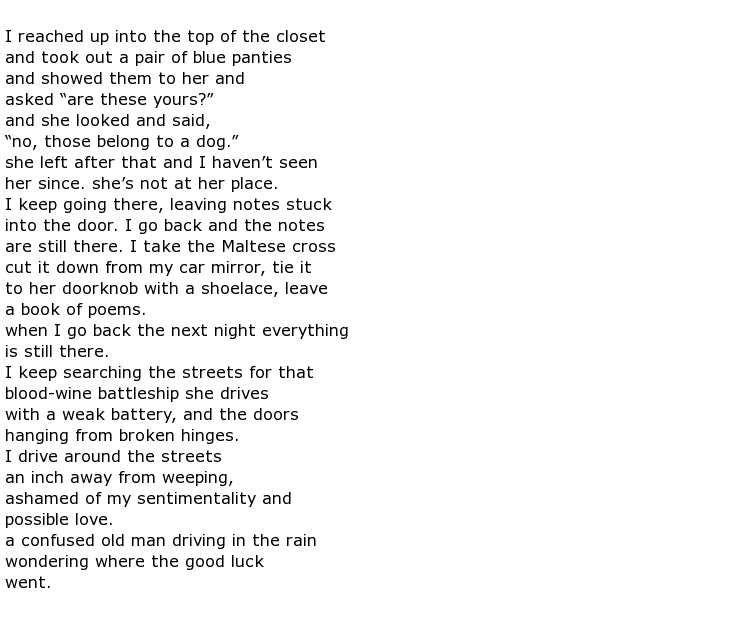
An old man NOT focused on his age
An ever going theme within his poems, Charles Bukowski states that he is not at all concerned with being old. Of course this is his humor, as a great deal of his poems focus on him being an old man. One can assume that he either (and in probability) meant this to be understood as false, or that he was just unaware that he placed such an emphasis. Regardless of which stance one takes, it is clear that the old man comes forward as the dominant character within these poems.
Old man that he is, the character developed as the poet within Charles Bukowski’s poems (whether they are the true character of Bukowski or just his interpretation of himself) has an infatuation with the younger sex. Nearly every poem written shows references to the female sex and the desire to engage in consummation with such, or the results of debauchery with a woman.
The gravestone
If one were to visit the grave of Charles Bukowski, one would find on the tombstone the words “Don’t Try”. At first glance, one would most assuredly take this to be a call to quit, to give up the pursuit, or to abandon vision. However, this is not at all what was intended. The poet quoted this phrase as the methodology for creative writing and for any pursuit in life. His (if you will call it such) theology to life was to let it come and let it happen. To try to mold writing would be to tarnish the validity of the thought and the pureness of the creation. He stated.

Blunt and to the point, Charles Bukowski may be the modern poet which so many individuals would like to be should the world and society not have such a judgmental nature. The poet put everything that life presented to him on paper. Where there are poets which focus on the naturalistic and mystical aspects of the world, Bukowski focused more on the realistic cruelties and ironies which life presents. The melancholy in which his poems are presented makes the reader question whether or not the poet ever reached a peace within his soul. Was the character he portrayed on paper his true inner man or was it just the fictitious personification of an old man?